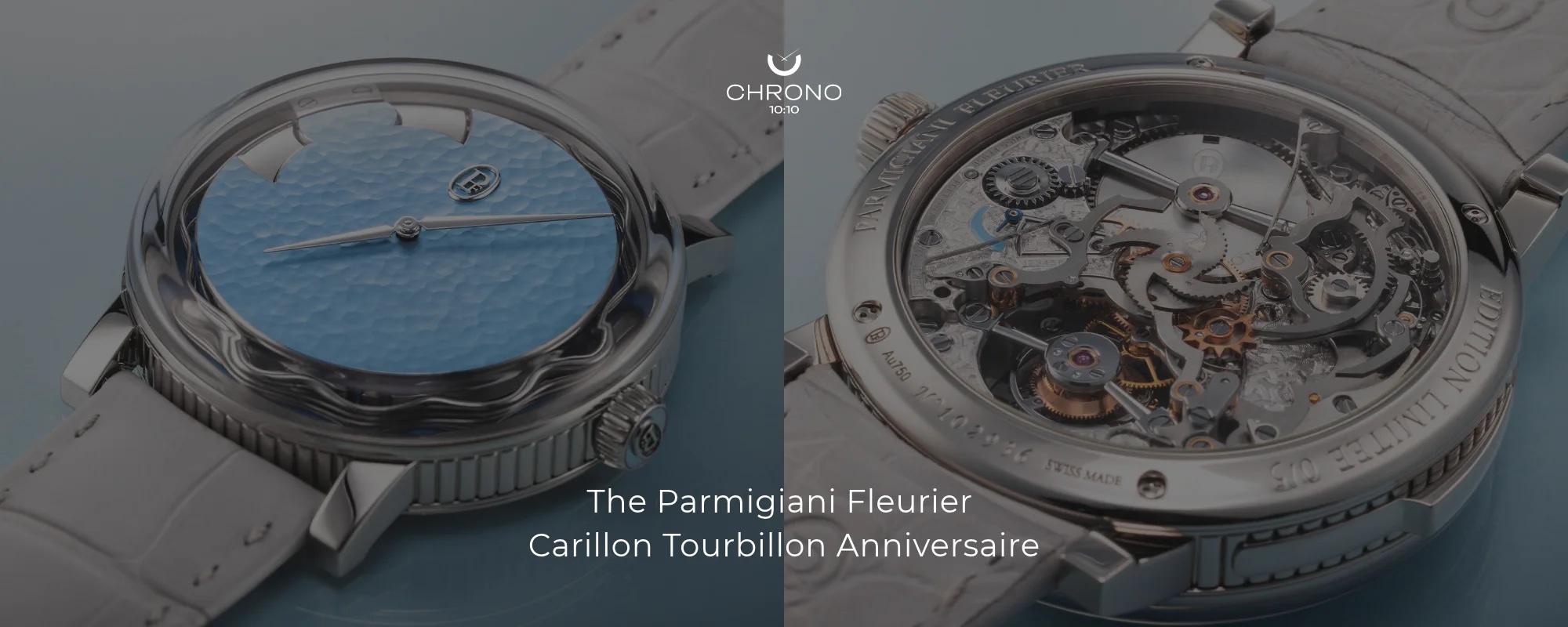
Why a Watch That Chimes Costs Half a Million Francs
Parmigiani Fleurier made five of these. Each one costs 490,000 Swiss francs.
Source: hodinkee.com
The watch is called the Carillon Tourbillon and it does something most people have never seen a watch do. You push a slide on the side of the case, and the watch tells you the time out loud. Low tones for the hours. A short tune for each quarter hour. High tones for the minutes after that. If it is 4:52, you hear four low notes, three little tunes, then seven high notes, and you count them.
That is a minute repeater, and it has been the hardest thing in watchmaking for about three hundred years. Here is why.
It Was Built for the Dark
Before electric light, checking the time at night meant getting out of bed and lighting a candle. Watchmakers in the 1700s solved this by making watches you could hear. Push a button and the watch tells you the time without you opening your eyes.
Then somebody invented the light bulb and the whole idea became pointless. The repeater survived anyway, because by then people had worked out that a chiming watch was the finest thing a watchmaker could build. It stopped being useful and became a way of showing what you could do.
Every repeater made today is a solution to a problem nobody has.
Source: hodinkee.com
Making Metal Sing Inside a Metal Box
The sound comes from two things. Hammers, which you can see on the dial of this Parmigiani at ten o'clock, and gongs, which are long thin wires of hardened steel coiled around the edge of the movement. The hammers hit the gongs. The gongs ring. The case picks up that ring and pushes it out into the room.
Every part of this fights you.
The gong has to be the right length and the right thickness to make the right note, and the only way to get there is by hand. A watchmaker files a bit off, listens, files a bit more, listens again. He is aiming for a specific pitch by ear. When he gets it right for one watch, that setting does not carry over to the next one, because the case is a slightly different shape and the metal came from a different batch. Every repeater gets tuned on its own.
Source: hodinkee.com
Then he has to attach the gongs so the sound reaches the case without the movement absorbing it first. Then the whole thing gets sealed up, and if the sound comes out weak or flat or buzzing, he takes it apart and starts again. A master might spend months on one watch and still not be happy.
There are maybe a few dozen people alive who do this properly. That is the real reason for the price. You are paying for a very small number of hands.
Gold Sounds Worse Than Steel
Here is the part that annoys wealthy buyers. Gold is heavy and dense and it soaks up sound. Steel and titanium are lighter and ring better. So the cheapest metal makes the best-sounding repeater and the most expensive metal makes a quieter one.
Most brands build repeaters in gold or platinum anyway, because a customer spending half a million francs expects a precious metal, and the watchmaker works around it. This Parmigiani is white gold. A few brands have made steel and titanium repeaters and collectors chase them hard.
Source: hodinkee.com
Water resistance causes the same problem. A sealed case with thick gaskets keeps water out and keeps sound in. Most repeaters have almost no water resistance at all. You take the watch off before you wash your hands.
What Carillon Means
A normal minute repeater has two gongs. One low note and one high note, and the quarters are played as a pair, low then high.
A carillon has more. This Parmigiani has four gongs, which you can see as the wavy lines around the edge of the dial, so the quarters get a proper little four-note tune. The word carillon comes from church bell towers, where a set of tuned bells plays a melody. Adding gongs adds hammers, adds levers, adds parts that all have to fire in the right order in the right fraction of a second. It sounds better and it is much harder.
The design of those gongs came from an old pocket watch. Parmigiani started as a restoration workshop, and in 2000 they restored a piece from the early 1800s with curved snake-shaped gongs. Those curves are what you see on the dial today.
The Clever Bit
Here is the thing in this watch that I like most. It is a small idea and a smart one.
In almost every repeater, the chiming runs off the same mainspring that runs the watch. Every time you make it chime, you steal power from the timekeeping. Play with it too much and the watch stops early.
Parmigiani gave the chiming its own separate barrel. And it gets wound by the slide itself. Every time you push the slide to hear the time, you are also winding the spring that powers the sound. The timekeeping side keeps its full ten days of power no matter how many times you play with the thing.
Ten days is a long reserve for any watch. For a repeater with a tourbillon in it, it is a lot.
The Watch Itself
41.6mm across, 12.6mm thick, white gold. The dial is solid gold hammered by hand, so each of the five is slightly different, in a pale blue they call Morning Blue. There is no text printed on it anywhere. One applied logo and nothing else.
The movement is called the PF950, hand-wound, with the carillon repeater, a one-minute tourbillon and that ten-day reserve. The bridges are hand-engraved. The back is busy and the front is calm, which is how Parmigiani builds most things.
Source: hodinkee.com
Who Buys This
Five people, and none of them will wear it much.
That is worth saying plainly, because it explains what a watch like this is for. You cannot hear a repeater in a noisy room. You cannot show it off at dinner. The chime is quiet, it is meant for one person, and half the time you activate it you are alone.
So the buyer is someone who spends 490,000 francs on a sound only he will hear, made by a handful of people who tuned it by ear, to solve a problem the light bulb fixed a hundred and forty years ago.
I find that easier to respect than most things at this price. A watch that costs half a million because it has diamonds on it is a purchase anyone can understand. This one costs half a million because a man sat at a bench filing a piece of steel wire until it sang the right note, and then did it three more times.
Související články