Vanguart, and What You Are Actually Buying at 150,000 Francs
Clients who have bought the Rolexes and added a Patek often ask the same question, which is what comes after that. They are not asking about microbrands. They mean the small independent workshops making watches that stand comparison with the great houses on mechanical merit, and there are perhaps a dozen worth knowing about. Vanguart is one of them, and since the brand has started appearing on well-known wrists, it is worth explaining what it is and where the risks sit.
The company was founded in Switzerland in 2017 by four people, and the composition of that group tells you most of what you need to know.
Jérémy Freléchox spent fifteen years at Audemars Piguet Renaud & Papi, and six years at Girard-Perregaux before that. He runs the technical side. APRP is worth a sentence of explanation, because outside the trade almost nobody has heard of it. It is the workshop where Audemars Piguet develops the mechanics it cannot develop in-house, the concept pieces and the complicated work, and over three decades it has trained a significant share of the best technical watchmakers in the country. Axel Leuenberger, now the chief executive, also came from APRP and conceived the brand's first watch. Thierry Fischer handles design.
The fourth founder is Mehmet Korutürk, who came from private equity by way of Formula 1. In my experience this is the position that decides whether a small watch brand lives or dies. Very few of them fail because the watchmaking was poor. They fail because a supplier goes under, or because eighteen months pass between taking a deposit and delivering a watch, or because a slow year arrives before the reserves are deep enough to absorb it. Vanguart brought in someone who understood that from the start, which is less romantic than the watchmaking and more predictive of survival.
The Black Hole
The first watch appeared in 2021. The case is titanium, 45mm across the diagonal, and the dial curves downward into a funnel with a flying tourbillon at the centre, held from below so that no bridge crosses over it. There are no hands. The time is displayed on three discs turning inside the funnel wall, showing hours, tenths of minutes and minutes, and the discs advance in steps rather than sliding continuously. Setting is done with a small joystick rather than a crown. The movement, calibre T-1701, is wound by hand and contains 775 parts, with the mainplate and bridges in grade 5 titanium. The complete watch weighs 80 grams.
Prices were around 320,000 francs in titanium and 350,000 in gold.
The reception was divided in a way that seems fair to me in hindsight. The engineering impressed people who examined it closely. The watch itself was widely considered oversized and overloaded, and it was priced well beyond most of the collectors who admired it. That is a common outcome for a first watch from an ambitious team. When there is no existing customer to disappoint, everything the founders have ever wanted to build tends to end up in the same case. What matters commercially is the second watch.
The Orb
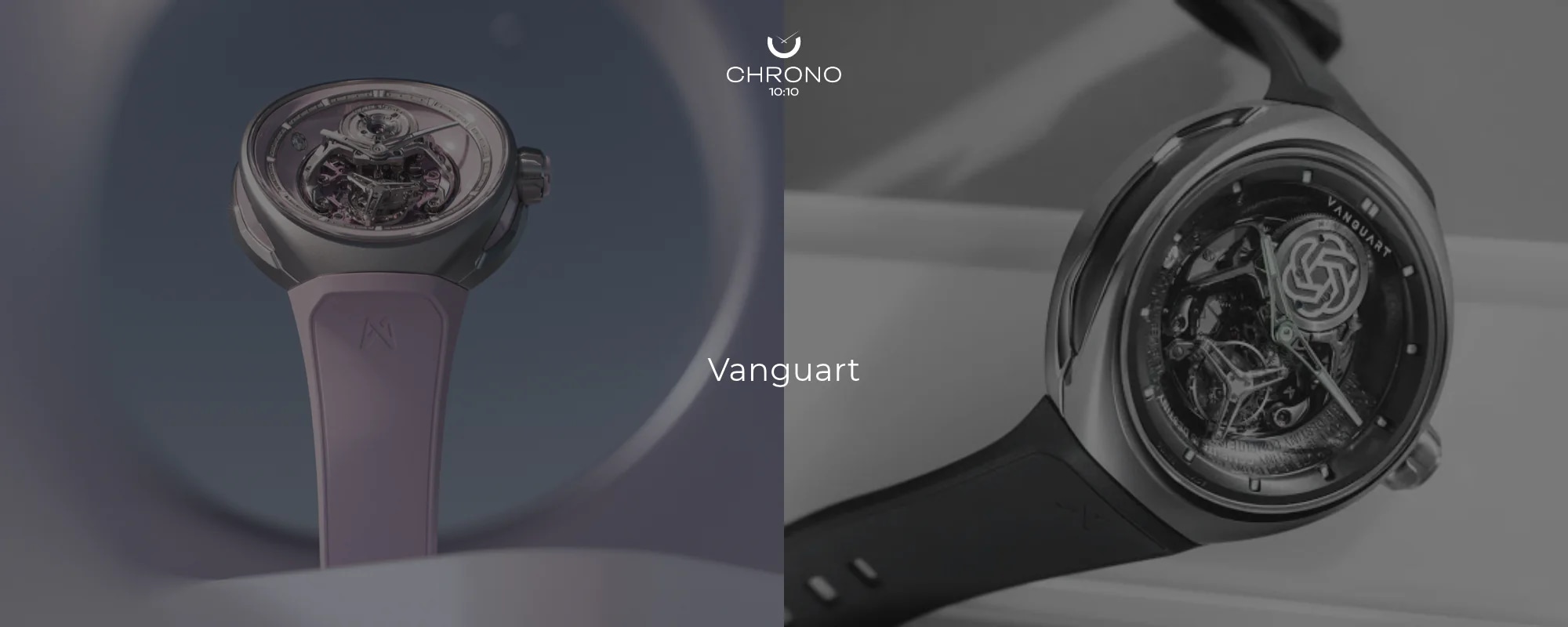
The second watch keeps the brand's design language and reduces the volume considerably. The case is rounded rather than angular, and the flying tourbillon sits at the centre of a skeletonised movement built in visible layers.
Two engineering decisions in it are worth describing, because they explain what the money is buying.
The first is the winding system. In a conventional automatic watch, the rotor is a heavy semicircle mounted on top of the movement, and it obscures roughly half of the mechanics. Vanguart used a peripheral rotor instead, which is a ring that runs around the outer edge of the movement. Nothing sits above the mechanics, so the whole movement remains visible. It is more difficult and more expensive to build, and the reason for doing it is entirely visual.
The second is a selector that switches the movement between automatic and manual winding. Left on automatic, the watch winds itself as the wearer moves. Switched over, the rotor disengages and the watch is wound by hand. There is no technical necessity for this. It exists because some owners prefer to wind a watch themselves, and the brand decided to let them choose.
The rest of the specification holds up. The calibre runs at 3Hz with a free-sprung balance and variable inertia, which is the more difficult of the two common regulating systems and the one Rolex and Patek Philippe use, chosen because it holds its rate more reliably over a period of years. Power reserve is 60 hours. The movement measures 31.2mm in diameter, which is large enough that the case has been built around the mechanics rather than a small movement being fitted into a large case behind a spacer ring. The strap releases with a pair of pushers and no tools, which is a courtesy that watches at three times the price frequently do not extend.
Prices are approximately 150,000 francs in titanium and 180,000 in gold. Ed Sheeran was photographed wearing one on stage recently.
Where the Value Question Sits
At this level, the question worth asking is who developed the movement, and it is asked far less often than it should be.
There are respected brands in this price bracket whose watches are excellent and whose movements were designed and built by an outside workshop under a confidentiality agreement. This is legal, normal, and not disclosed. What the customer is paying for in those cases is the design, the finishing and the name, all of which have real value, but the development did not happen at the brand.
Vanguart's position is different mainly because its founders came out of that supplier world themselves, and the development is happening inside the company. The cost of that is worth understanding. Developing a proprietary calibre runs into the millions regardless of how many watches are eventually sold, and Vanguart expects to produce roughly one hundred watches a year. Every buyer is therefore carrying a substantial share of the development bill. Whether that constitutes value depends entirely on whether the origin of a movement matters to you. For a good number of collectors it does not, and there is nothing wrong with that position.
What I Would Watch For
The relevant risk is not quality. It is continuity.
Brands of this size usually survive their first watch on novelty and their second on the relief that the founders can edit themselves. The third watch is where you learn whether there is a coherent point of view underneath, or whether the first design was simply a strong idea being reworked. The Black Hole was the idea and the Orb was the correction. Whatever follows will tell you more about the brand's prospects than either of them.
The market has also cooled since 2021. Secondary prices have softened across most of the industry, and a company producing a hundred watches a year has limited capacity to absorb a difficult period. That is not a prediction of failure. It is the ordinary risk of buying early from a young manufacturer, and it should be priced into the decision rather than ignored.
Související články