The Watch Named After a Submarine That Went Deeper Than Anything Ever Had
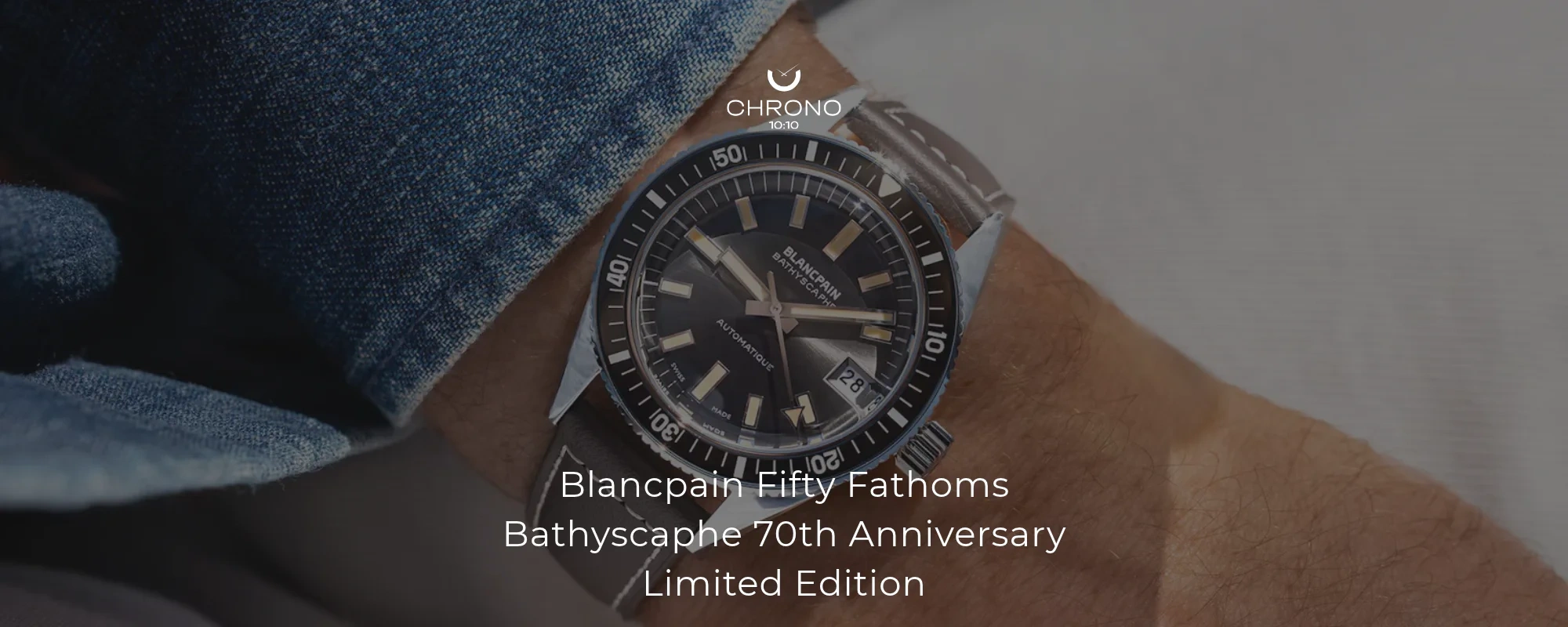
Blancpain has released a 300-piece limited edition of the Fifty Fathoms Bathyscaphe for the model's seventieth birthday, and it is a careful, almost fussy reconstruction of a version from 1968, right down to the old company logo. It costs $18,300, the case is 37.4mm of steel, and the whole thing is lovely in a way that makes you want to know why it exists at all.
Source: Hodinkee.com
Which is where this gets interesting, because the Bathyscaphe was never really a watch for divers. It was the small one, the polite one, the version you wore to dinner after a day on the boat, and it took its name from the most extreme piece of engineering of its era.
Two Frenchmen Who Could Not Find a Watch
The story starts three years earlier, in 1953, with a problem the French Navy had failed to solve. Captain Robert Maloubier and Lieutenant Claude Riffaud were building the navy's combat swimmer unit, and while they could source fins, masks and breathing gear without much trouble, they could not find a single watch that survived being taken underwater and remained readable in the dark. They tried what was available, ruined most of it, and eventually went looking for someone who would build what they described.
They found Jean-Jacques Fiechter, who ran Blancpain and happened to be a serious diver himself, which came in quite handy. Fiechter had once nearly run out of air on a dive because he lost track of how long he had been down, and that experience shaped the watch he designed more than any military specification did.
The result arrived in 1953 and is generally treated as the first modern dive watch, though Rolex was working on the Submariner at the same time and collectors have been arguing about the order ever since. The name came from the depth limit of the day, since fifty fathoms is a little over ninety metres, which was as deep as anyone could safely go breathing compressed air.
The clever part was the bezel, and it is worth understanding because every dive watch made since has copied the logic. You set the marker against the minute hand when you enter the water and read your elapsed time off the bezel, so if the bezel gets knocked and rotates freely, your reading changes and you might believe you have more air than you do. Fiechter made his bezel turn one way only, and he locked it, so that any accidental movement can only ever tell you that more time has passed than really has. The watch is designed to lie in the direction that sends you up early.
Jacques Cousteau's team wore them while filming The Silent World, which won the Palme d'Or and then an Academy Award, and put the watch in front of an audience that had never thought about diving at all.
Source: Hodinkee.com
Where the Name Comes From
By 1956, diving had become a hobby rather than strictly a military job, and Blancpain built a smaller civilian version at 35mm. They called it the Bathyscaphe, and that word was not decoration.
A bathyscaphe was a real vessel, invented by the Swiss physicist Auguste Piccard, built to sink deliberately into water too deep for any submarine of the period. The most famous of them was assembled in Italy and named Trieste after the city where much of the work was done, and in January 1960 Piccard's son Jacques and a US Navy lieutenant named Don Walsh rode it to the bottom of the Challenger Deep in the Pacific, almost eleven kilometres down, which remains the deepest anyone has ever gone in the ocean. Rolex, always alert, had strapped an experimental watch to the outside of the hull.
So while Rolex was bolting a watch to the vessel, Blancpain had already named a whole product line after it, and there is a nice irony in the fact that the Bathyscaphe was the small, gentle, civilian member of the family while its namesake was doing the most violent descent in human history.
What They Took From 1968
The watch Blancpain has copied here is a Bathyscaphe from 1968, and the choice of year explains most of the decisions, starting with the size, since 37.4mm follows the late-sixties reference instead of the 35mm original from 1956.
The dial is a sunburst grey they call meteor, taken from the same watch, with baton hands and markers in white gold filled with Super-LumiNova that has been tinted to look like sixty-year-old lume. The bezel now carries a ceramic insert where the 1968 version used hesalite, which means the numerals will still be there in twenty years, and the steel of the bezel extends into a ring at the base of the domed crystal, a detail lifted straight from the old watch. The old Blancpain logo is back on the dial, which is the sort of decision brands agonise over and which almost always turns out to be right.
The case is 12.3mm thick with a 46.5mm lug-to-lug measurement, so despite the modest diameter it wears with some presence, and water resistance is a serious 300 metres. Where the original had a solid back, this one is sapphire, showing the calibre 1150 with its winding weight cut in the pattern used on the 1953 Fifty Fathoms, and the movement runs 100 hours on a full wind with a silicon hairspring that ignores magnetic fields. It comes on chocolate calf leather with a five-year warranty, individually numbered, available now.
Source: Hodinkee.com
What I Think
The size is the thing that will decide this for most people, because 37.4mm on a dive watch reads as small in a market that spent twenty years telling everyone that 42mm was normal, and yet it is exactly the size these watches were before the industry lost its mind. If you have been curious about smaller watches, this is a good one to try on, since the thickness and the lug span give it more wrist presence than the diameter suggests.
I have mixed feelings about lume that arrives pre-aged, because you are buying the look of six decades of slow chemistry without the six decades, and it will still be that same colour long after a genuine tritium dial would have kept moving. On this watch it works, and I say that as someone who usually grumbles about it, because the whole piece is a deliberate reconstruction rather than a modern watch wearing a costume.
Source: Hodinkee.com
The strap choice is the one decision I would question, since 300 metres of water resistance on chocolate calf leather is a slightly odd pairing, and anyone planning to swim with it should budget for rubber straight away.
At $18,300 you are paying roughly Submariner money for a watch with a hundred-hour movement, a much better story, and 299 friends instead of a production run measured in the hundreds of thousands, which is a trade I would make. Just be honest with yourself that you are buying it for the story, because that is the real reason anyone buys a Fifty Fathoms, and it happens to be one of the few stories in this business that is entirely true.
Související články