The Rolex Perpetual Padellone Is Rolex Aiming Straight at Patek Philippe
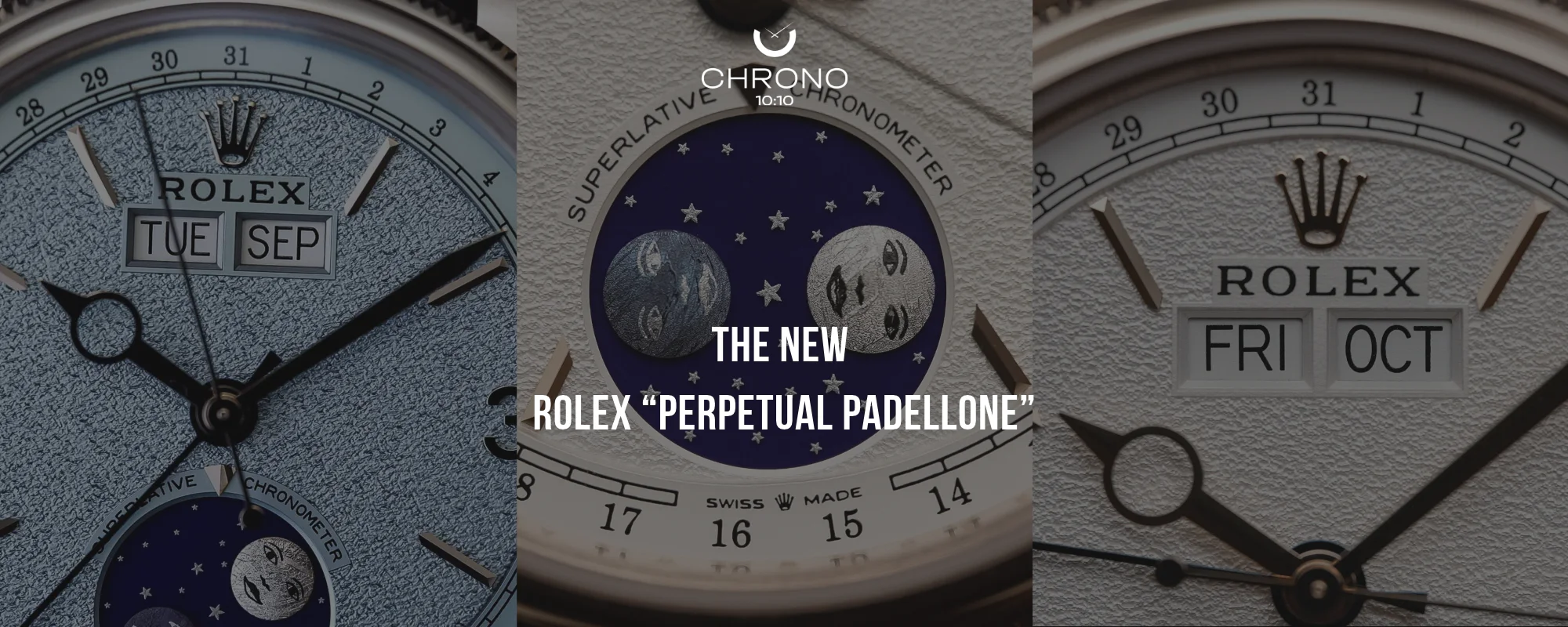
Rolex went to Milan this week, outside its usual launch calendar, and introduced an annual calendar with a moon phase called the Perpetual Padellone. It comes in Everose gold at 59,000 dollars on a strap and 72,800 on a bracelet, and in platinum at 66,200 on a strap. The case is 39mm across and 12.2mm thick.
Source: Hodinkee.com
Those numbers put a Rolex in a room it has never really entered, and the watch itself is the most technically ambitious thing the company has built for a dress case in seventy years. Both of those facts deserve unpacking, along with a third one that almost nobody has commented on.
Rolex Named a Watch After a Collector Nickname
Start with the name, because it tells you something about how this company has changed.
In 1949 Rolex made a triple calendar called the reference 8171. It was 38mm at a time when that was enormous, it had a domed dial, and it was not waterproof. Italian collectors nicknamed it the Padellone, meaning big frying pan, and the name stuck for seventy years in the collecting world while Rolex said nothing.
Rolex has always refused to acknowledge these names. The Pepsi, the Batman, the Hulk, the Coke, none of them appear in any Rolex document, and the company has spent decades letting collectors use a private vocabulary it pretended not to hear.
This watch is called the Padellone. Officially, on the press release, in the catalogue. As far as I can tell it is the first time Rolex has taken a name invented by collectors and made it its own, and the launch happened in Milan, which is where vintage watch collecting largely began.
Read that alongside what else Rolex has done recently. It started a certified pre-owned programme in 2022 after ignoring the second-hand market for a century. It bought Bucherer in 2023. It is running a charity auction of unique Daytonas through Phillips this month. A company famous for talking to nobody has started talking to collectors in their own language.
Source: monochrome-watches.com
What an Annual Calendar Knows
A normal date window knows that a month has 31 days and nothing else. At the end of April, June, September and November it shows 31 anyway, and you correct it by hand five times a year.
An annual calendar knows the difference. It carries a mechanical map of month lengths, so it skips from 30 to 1 in the short months on its own, and shows the day and month as well. The one thing it cannot handle is February, which is 28 days most years and 29 occasionally, so the owner corrects it once a year on the first of March. A perpetual calendar handles February and leap years too, which takes a great deal more mechanism and money.
Patek Philippe invented the annual calendar in 1996, which makes this year its thirtieth. The Padellone is only Rolex's second one, after the Sky-Dweller, and the first in a dress watch.
The Hard Part Is Midnight
The engineering that separates this watch from most of its rivals sits in one moment of the day.
On many calendar watches the date does not jump. It begins creeping forward some time before midnight and finishes some time after, and for twenty or thirty minutes you are looking at a date disc caught between two numbers. That approach is cheap in energy terms, because the mechanism borrows a tiny amount of power continuously.
An instantaneous calendar snaps. At midnight the day, the date and the month all change at once, in an instant, and on the last day of a short month the date skips an extra step to land on the first. Doing that requires a burst of force, and a mainspring does not produce bursts.
So the movement stores energy through the day. A spring called an accumulator presses a roller against a cam that turns once every twenty-four hours, tensioning a little more with every hour that passes. At midnight the roller reaches the edge of the cam, slips off, and the stored energy releases all at once into the fingers that push the calendar displays forward. The watch has been winding up a small catapult all day for one movement you will probably be asleep for.
Source: monochrome-watches.com
That is why fewer brands build these. You need more parts, more space, more torque, and the parts have to stay flat enough not to inflate the case. It also traditionally creates what watchmakers call a danger zone, a window of a few hours around midnight when the calendar mechanism is engaged and using the correctors can break it, which is how a great many calendar watches end up back at the service centre.
Rolex's patent, filed in August 2025, addresses all of it. The correctors on this watch can be used at any time of day, which removes the single most common way for an owner to destroy an expensive complication.
Why Dynapulse Had to Come First
The movement is the calibre 7190, and it descends from the 7135 that Rolex introduced in the Land-Dweller last year along with a new escapement called Dynapulse.
Source: monochrome-watches.com
A conventional Swiss lever escapement works through an intermediary. The escape wheel pushes a pallet fork, the pallet fork pushes the balance, and every one of those handovers involves surfaces sliding against each other, losing energy to friction and requiring lubrication that degrades over time. Dynapulse removes the intermediary from the power path and lets the escape wheel impulse the balance directly. Rolex claims it is around 15 percent better than its own Chronergy escapement, which was itself about 15 percent better than a standard lever.
It exists because of silicon. The parts have shapes that could not be machined in steel, and Rolex makes them using deep reactive ion etching, a process borrowed from semiconductor manufacturing that carves silicon wafers with vertical walls at microscopic scale. The parts are hollowed out to reduce mass, and silicon ignores magnetic fields, which matters because the balance runs at 5Hz.
The connection to this watch is the part that often goes unmentioned. An instantaneous annual calendar is an energy problem before it is anything else. Rolex needed a meaningfully more efficient escapement before it could put this calendar into a 12.2mm dress case and still certify the watch to two seconds a day. The escapement came first because the calendar could not have existed without it.
Source: monochrome-watches.com
The Watch Itself
The dial keeps the old layout. Day and month in two apertures under twelve, the date read by a blue hand tipped with a crescent that points at a scale around the edge, and the moon at six.
That moon phase is the prettiest thing here. The disc is enamel, and the full moon and new moon are cut from meteorite, with the new moon treated in dark blue, both printed with faces in a style taken from the 8171. The disc turns once every 29.53 days and stays fully visible instead of hiding behind a half-aperture the way the vintage watch did.
Source: monochrome-watches.com
The case follows the 1908, with a fluted bezel sitting above a polished midcase and a slightly tapered fluted crown. The Everose versions get a grained white dial, the platinum gets Rolex's ice blue, which is the colour Rolex reserves for platinum and which does more work here than in most places it appears.
Source: monochrome-watches.com
Four correctors sit on the case band, operated with a supplied stylus, for day, month, moon and date. Water resistance is 50 metres, which is fine for a dress watch and worth a small smile given that the original Padellone was not water resistant at all.
Source: monochrome-watches.com
The Price, and Who Else Is Selling at It
Fifty-nine thousand dollars is a number that will make people flinch, because Rolex has spent a century being the most expensive watch a normal person could aspire to, with the true luxury tier left to other names. Placed against the actual competition, it reads differently.
Patek's 5396R, the direct rival and the descendant of the watch that invented this complication, costs around 67,500 dollars in rose gold, on a strap, with 30 metres of water resistance. A. Lange & Söhne's Saxonia Annual Calendar is about 75,000, thinner and more beautifully finished, strap only. Parmigiani's Tonda PF Gregorian is roughly 97,000 with a bracelet. Laurent Ferrier's Classic Moon is around the same. Blancpain's Villeret annual calendar with a GMT undercuts everyone at 57,400.
So the Rolex is the cheapest serious option in gold apart from the Blancpain, and it is the only one offering a bracelet below ninety thousand dollars. It also has the best stated accuracy of the group by a distance, since Rolex certifies every watch to two seconds a day either side and most of these brands publish no figure at all.
Inside Rolex's own catalogue it makes sense too. A rose gold Sky-Dweller, the other annual calendar, is about 64,900 dollars. The Padellone in the same metal on a strap costs less than that.
What you give up against the Patek and the Lange is hand-finishing. Those companies do work by hand on bridges and levers that Rolex does by machine to an extremely high but industrial standard, and if that is what you value, no amount of escapement efficiency compensates. What you gain is a movement that is measurably more advanced, a calendar you cannot break by adjusting it at the wrong hour, and a watch you can have serviced almost anywhere in the world for the next forty years.
Who Should Be Looking at This
The clearest buyer is someone who loves mid-century calendar watches and has watched that market leave the planet. A good 8171 is a serious sum. A 6062 sold for 6.2 million dollars at auction last year. Patek's 2497 and 1526 are museum pieces now. This watch puts the look, the layout and the pointer date into something you can wear in the rain, get serviced, and buy new.
The second is the Rolex owner who has the sports watches and wants something else. There has never been a good answer to that question beyond a Day-Date, which is a different kind of statement entirely. A Padellone on the Settimo bracelet is a Rolex for someone who has stopped trying to impress anyone.
The third is the person who wants one complication that earns its place. An annual calendar is the most useful complication in watchmaking, because it tells you something you need every day and asks for thirty seconds of your attention once a year. A perpetual costs three times as much to save you that half minute.
It is a poor fit for anyone chasing hand-finishing, for anyone who needs a thin watch, since 12.2mm is not slim, and for anyone buying to flip. Precious metal dress Rolexes have never behaved like steel sports models on the secondary market, the 1908 rolled out slowly, and this will be worse. Expect to wait and expect your dealer to be vague about it.
The absence worth noting is steel. The original 8171 came in steel, a steel Padellone would have been the watch of the decade, and Rolex has decided the Perpetual collection is a precious metal line. That decision tells you what this collection is for, and it is not for most of the people who will read about it.
Související články