The Heart-Shaped Cam That Makes This Watch Possible
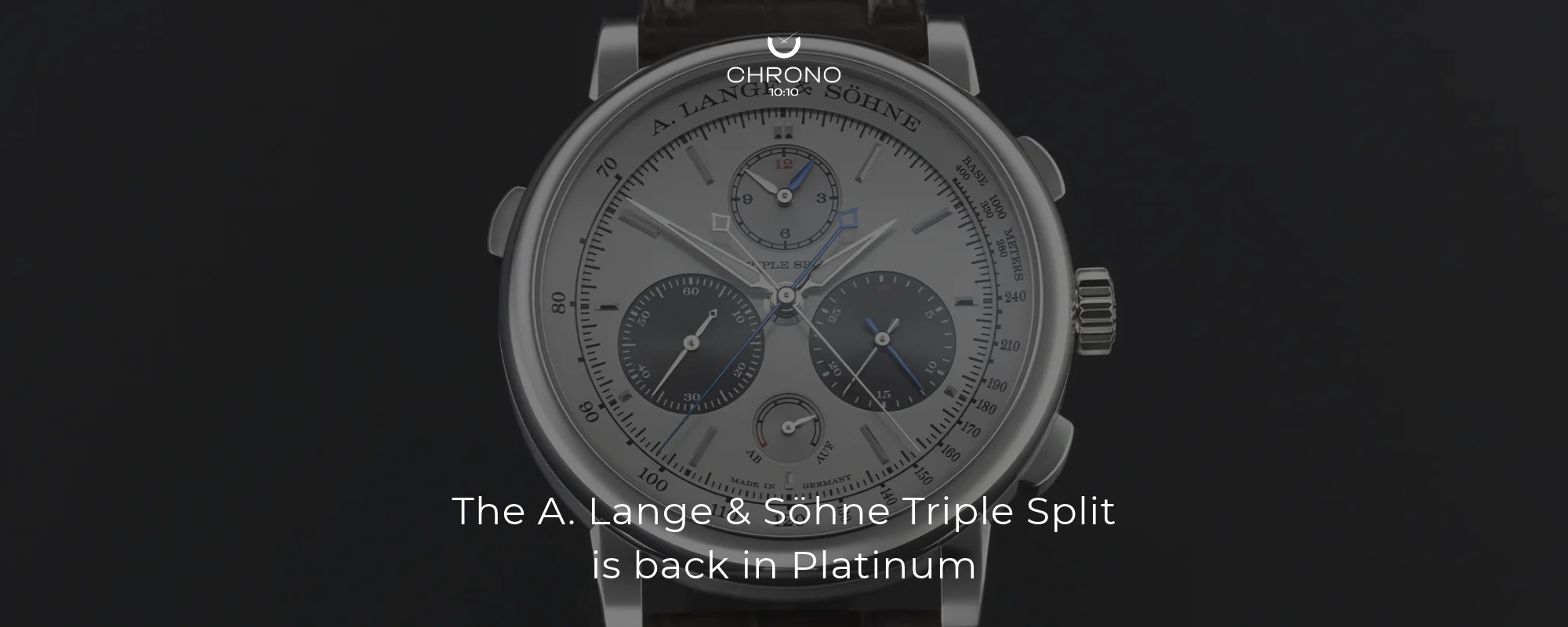
A. Lange & Söhne has brought back the Triple Split, this time in platinum, limited to 100 pieces at around 210,000 euro. It is the only wristwatch in the world that can time two separate events running up to twelve hours each and compare them against each other, and to understand why that sentence matters you have to look at a small piece of steel shaped like a heart.
Source: monochrome-watches.com
What a Split-Seconds Chronograph Does
Start with the ordinary version of this complication, which is difficult enough that most manufacturers have never built one.
A split-seconds chronograph, called a rattrapante from the French for catching up, has two chronograph hands stacked on the same axis, sitting perfectly on top of one another so that you see only one. You start the chronograph and both hands sweep together. Press a second pusher and one hand freezes while the other carries on. Now you can read the first runner's time while the second is still out on the track. Press again and the stopped hand vanishes, instantly, back underneath the running hand as though it had never paused.
That last part is the trick. The hand does not race around to catch up. It arrives, in the same instant you press the button, exactly aligned with a hand that has been moving the entire time.
Source: monochrome-watches.com
How It Catches Up
Underneath the dial, the stopped hand's wheel carries a small cam cut into the shape of a heart, and resting against that heart is a lever with a ruby roller on its end.
While the hand runs normally, the lever is held clear. When you press the split pusher, a pair of steel clamps closes on the wheel and holds the hand still, and the lever with its roller drops onto the heart cam. The mechanism underneath keeps turning the whole time, so the heart cam is now being held in a position it does not want to be in.
Release the clamps and the roller presses down on the sloping side of the heart, which forces the cam to rotate until the roller reaches the lowest point of the curve. There is exactly one position where that happens, and the heart is cut so that this position is the one where the two hands align. The whole catch-up comes down to a shape, pushed by a spring, that can only come to rest in one place.
The hard part is friction. While the hand is clamped, the mechanism it belongs to is still connected to everything turning below it, and any drag from those clamps travels back through the gear train to the balance wheel, robbing it of energy and changing the rate of the watch. Split-seconds chronographs have historically lost amplitude the moment you split them, which is a polite way of saying the watch keeps worse time exactly when you are trying to measure something. Solving that is where the watchmaking happens, and it is why so few companies bother.
Source: monochrome-watches.com
Then Do It Twice More
Lange built its first Double Split in 2004, adding the same splitting ability to the thirty-minute counter, so you could compare two events lasting up to half an hour. Nobody else had done it.
The Triple Split, first shown in 2018, adds the twelve-hour counter as well. Every one of those three counters needs its own pair of clamps, its own heart cam, its own roller and lever, and all of it has to release together, cleanly, on one press. Three separate catch-up systems that must behave as though they were one.
This is the reason the movement contains 567 parts, which is roughly double what a good conventional chronograph needs. Lange's own chief executive has said that the company's watchmakers would generally prefer to build a tourbillon or a perpetual calendar than a Triple Split. Inside a manufacture where difficulty is the daily business, this is the watch people avoid.
One Sixth of a Second
The balance runs at 21,600 vibrations per hour, which works out to six beats every second, and that number sets the limit of what the watch can measure. The chronograph hand advances in steps of one sixth of a second because that is how often the escapement lets the gear train move.
So the Triple Split measures from a sixth of a second up to twelve hours, on two events at once, with comparative readings available at any point along the way. In practical terms you could time two cars through an endurance race and know, at any moment, the exact gap between them.
Nobody does this. Nobody has needed to do this since electronic timing arrived, and the person spending 210,000 euro is not planning to stand at Le Mans with a platinum watch in his hand. The complication exists because it can be built, and because building it is close to the hardest thing in mechanical watchmaking that does not involve chiming.
Source: monochrome-watches.com
The Watch Around It
The case is platinum for the first time in this model's life, 43.2mm across and 15.6mm thick, which is large and heavy and entirely predictable given what has to fit inside. The dial is solid silver in two tones of grey, with rhodium-plated gold markers and lume at the quarters. The movement is hand-wound with 55 hours of reserve, 46 jewels, five gold chatons held by blued screws, and plates in untreated German silver.
The pushers are divided across the case, with the chronograph controls on the crown side and the split pusher sitting alone on the left, which keeps you from confusing the two under pressure.
A Note on the Money
Earlier Triple Splits from 2018 and 2021 have been trading on the secondary market at roughly what they cost new, which after five years and this much inflation means they have lost ground in real terms. That is worth knowing before anyone talks about this watch as an asset.
It also says something about who buys at this level. A watch that took decades of development, that Lange's own watchmakers approach with caution, and that no other company has managed to build, sells to a buyer with no interest in trading it. It goes to people who wanted the hardest thing in the catalogue and are content that the market has yet to agree with them. One hundred of them, this time.
Související články