The Carrera That Comes From a Loudspeaker Announcement at Fuji Speedway
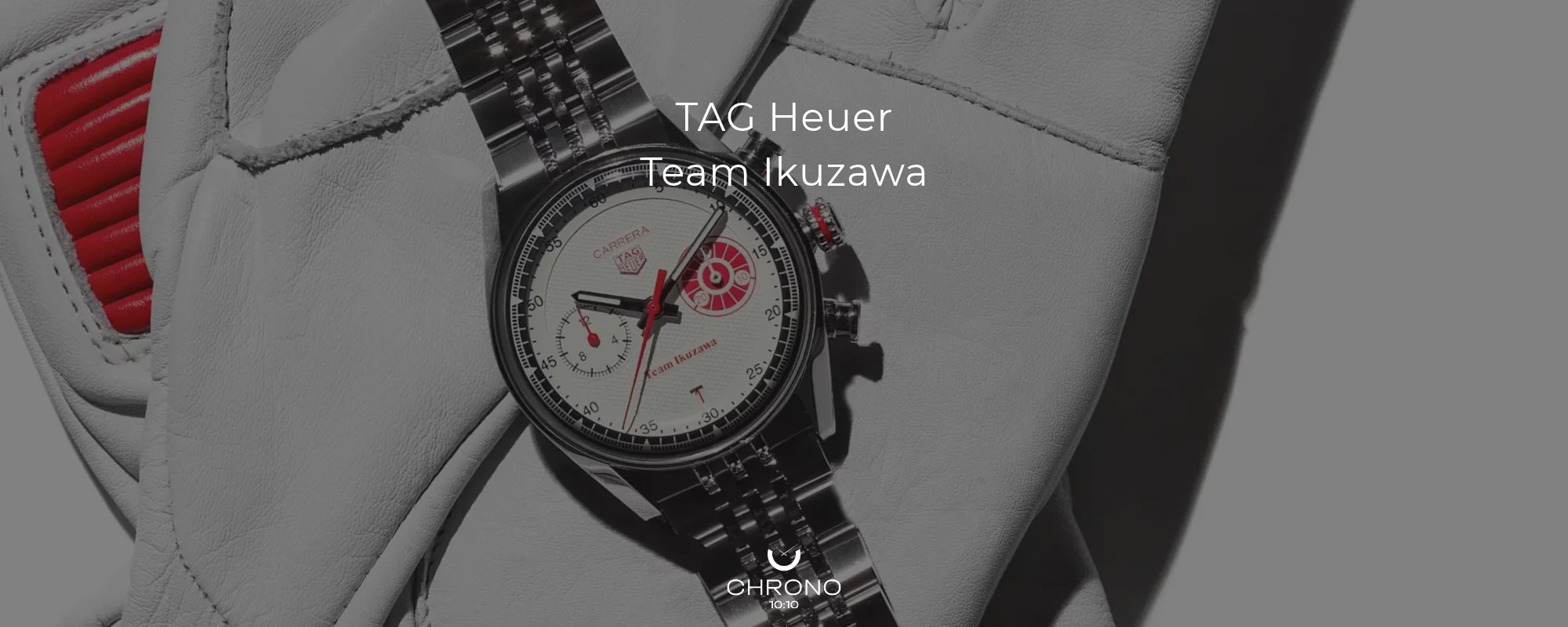
TAG Heuer has released a second Carrera chronograph with Team Ikuzawa and Bamford Watch Department, three years after the first one. It is a 39mm Glassbox Carrera in steel, white dial, red accents, limited to 150 numbered pieces at $10,500. Available now.
Source: Hodinkee.com
That is the news, and on its own it is a fairly ordinary piece of collaboration watchmaking. The reason I want to write about it is that the name on the dial belongs to one of the more remarkable stories in motorsport, and almost nobody outside Japan knows it.
Tetsu Ikuzawa
Tetsu Ikuzawa was born in Tokyo in 1942, the son of a well-known painter, and started racing motorcycles as a teenager before moving to cars with Prince Motor Company in the early 1960s. His 1964 Japanese Grand Prix drive in a Prince Skyline is the race Japanese enthusiasts still refer to when they talk about where the Skyline legend began.
In 1966 he moved to England to race professionally, which was close to unheard of for a Japanese driver at the time. In 1967 he won the British Formula 3 championship, the first Japanese driver to take a title of that kind in Europe. Later the same year he returned home and won the Japanese Grand Prix at Fuji Speedway in a Porsche 906 that he had arranged the backing for himself, rather than being handed by a works team. He went on to race Formula 2 in Europe, drove for Porsche as a factory driver, and appeared at Le Mans across three different decades.
None of that is why he matters to this watch, though. What matters is what happened at Fuji while he was racing.
His daughter Mai was born during a race weekend at that circuit. The news was announced over the track's loudspeakers while her father was on his way to a win. She has said publicly, including to Porsche's own magazine, that she is fairly sure he was hoping for a son.
What His Daughter Did With It
Mai Ikuzawa now runs Team Ikuzawa, and she is also a creative director at Bentley. The team still puts drivers into races, but its centre of gravity has moved. She describes what she does as car culture rather than motorsport, which is a distinction worth taking seriously rather than reading as a softening of her father's work.
The reasoning is practical. A racing team reaches the people who watch racing. A design and apparel operation with the same name reaches people who never will, and it does so without needing a budget that can compete with manufacturer teams. Team Ikuzawa employs three people in total, including her. She has said she finds it slightly embarrassing to call it a company at all.
There is an obvious version of this story where the daughter of a famous driver puts the family name on merchandise and calls it a legacy. This is not that. She has been careful about who the name goes near, and the people around her are a real part of how it works. One of them is Hiroshi Fujiwara, the Japanese designer behind Fragment, who has done his own TAG Heuer collaborations and who Mai refers to as an uncle. He is a godfather to one of her children. She talks about the whole thing in terms of reciprocity, of giving back as much as you take from the people who open doors for you, which is not the vocabulary most brands use when explaining a limited edition.
The connection to TAG Heuer is not invented either. Her father wore Heuer watches during his racing years, which is why the first collaboration happened in 2023 and why this one is a continuation rather than a launch.
Source: Hodinkee.com
Bamford's Part in It
George Bamford spent years customising other people's watches without permission, painting Rolexes black and generally being regarded by the industry as a nuisance. Then LVMH did something no other group had done and brought him inside, giving Bamford Watch Department official access to TAG Heuer, Zenith and Bulgari. That happened in 2017 and it is still the most interesting thing any large watch group has done about the customisation market, which had been growing regardless of whether the brands approved.
What Bamford brings to a project like this is not manufacturing. It is a working understanding of colour, restraint and the specific audience that buys collaboration watches, along with the ability to move faster than a large brand's internal design process usually allows. On a watch built around a Japanese design house's visual identity, that is the useful skill.
Source: Hodinkee.com
The Watch
Source: Hodinkee.com
The case is 39mm across and 13.86mm thick, brushed and polished steel, with the domed Glassbox sapphire that TAG Heuer has been using on the Carrera for the last few years. That crystal curves down over the edge of the dial, which magnifies the flange and gives the whole face some depth. It is the best thing to happen to the modern Carrera and it works particularly well on a busy dial like this one.
The dial is white with a Clous de Paris hobnail pattern, which is not a finish you expect to find on a racing chronograph. It usually turns up on dress watches, and putting it under red printing and black numerals is the sort of decision that either reads as confident or as too much, depending on the person looking at it. The Team Ikuzawa mark sits at six o'clock above a date window with red text, and the 30-minute counter at three o'clock has been given a design that looks more like a roulette wheel than a subdial. The hands carry red detailing and Super-LumiNova, and there is a red stripe around the crown.
Inside is TAG Heuer's TH20-10, an automatic chronograph with 80 hours of reserve, running at 4Hz, chronometer certified, with 33 jewels. Water resistance is 100 metres. The caseback is open but carries printed branding for both Team Ikuzawa and Bamford along with the individual number, which obscures part of the view. It arrives on a seven-row steel bracelet and comes with two additional straps, one white textile with red stripes and one perforated white leather with red stitching.
What I Make of It
At $10,500 for 150 pieces, this is not a watch anyone needs to think about as an investment, and I would be cautious about anyone presenting it that way. Limited collaboration chronographs from large brands have a mixed record on the secondary market, and 150 pieces is small enough to be scarce but not small enough to guarantee anything.
Source: Hodinkee.com
What it is instead is a well-built modern Carrera in the best case size the model currently comes in, decorated by people who understood the assignment, connected to a story that is worth more than the marketing usually attached to watches at this price. The Glassbox Carrera is a very good watch. The hobnail dial will divide people and I suspect that is intentional.
If the white and red does not work for you, the standard Glassbox Carrera is a quieter watch and considerably easier to find. If it does work for you, the thing you are actually buying is a small piece of the Ikuzawa story, and that story is better than most.
Related Articles