Rolex Made Four Watches It Could Not Figure Out How to Sell
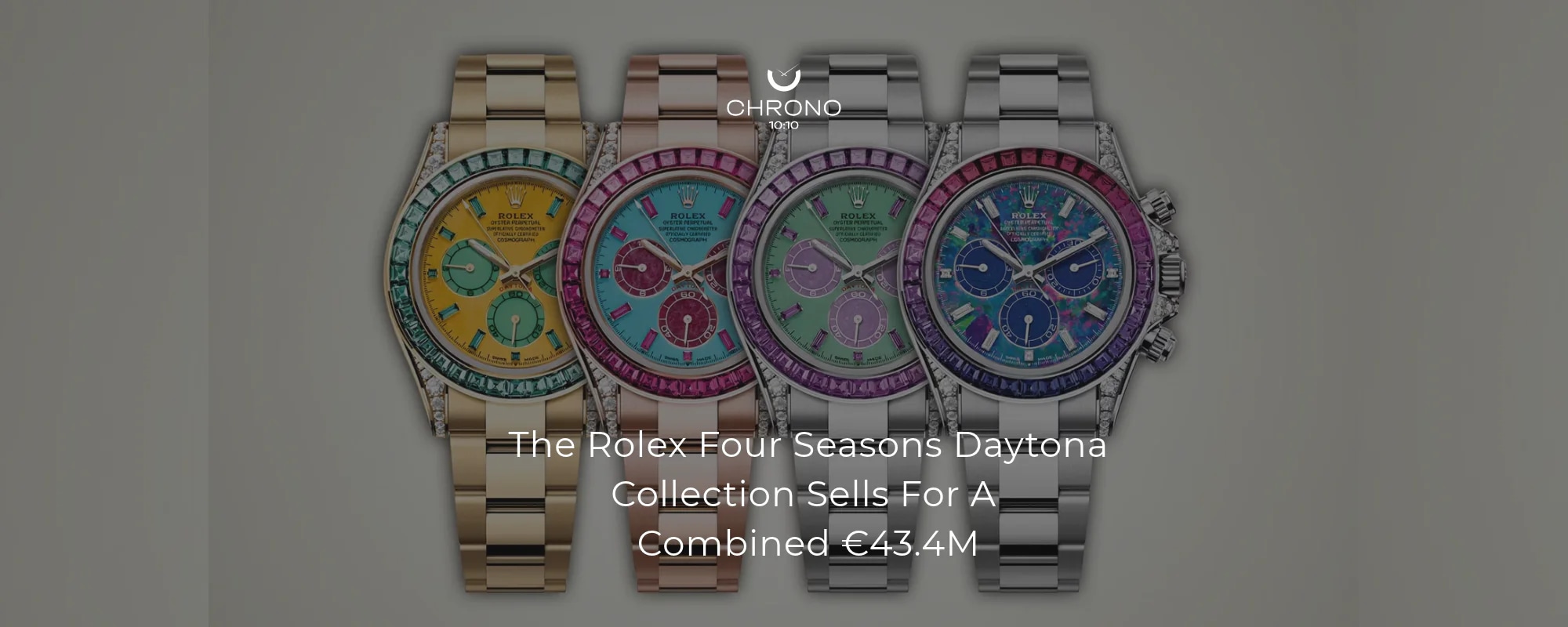
On 28 September, Phillips auctioned four unique Rolex Daytonas in London, with everything raised going to Roger Federer's foundation and to Re, the conservation organisation co-founded by Leonardo DiCaprio. The watches were built as a set around the theme of the four seasons, each in a different metal with a different combination of hardstones, and each is the only one of its kind.
Read that last part again, because it is the strangest sentence anyone has written about Rolex in years.
The four watches sold for a combined €43.4 million. Summer achieved €12 million, Autumn €11.9 million, Winter €11.6 million, and Spring €7.9 million.
Summer
Spring
Winter
Autumn
A Company That Does Not Make One of Anything
Rolex produces somewhere around a million watches a year, and the entire machine is built for repetition. The same case, the same movement, the same dial, made to the same standard, in enormous numbers, year after year. Consistency is the product. It is why a Submariner bought in Prague is identical to one bought in Tokyo, and it is why the brand became what it is.
Unique pieces work against all of that. Rolex has made a handful over the years for the Only Watch charity auction, and beyond those the company has been close to silent on the subject. It does not do artist collaborations. It does not do one-offs for celebrities, at least not publicly. When a watch turns up at auction described as a Rolex prototype or a special order, the company itself will rarely confirm anything about it.
Rolex has also spent most of its history pretending the second-hand market did not exist. That only changed in December 2022, when it launched a certified pre-owned programme, and then again in 2023 when it bought Bucherer, one of its own largest retailers. Both moves would have been unthinkable a decade earlier.
So a Rolex charity auction of four confirmed unique watches, run through Phillips, was a break from a century of behaviour.
The Part Nobody Planned
The set was originally meant to be sold privately. Rolex asked its retailers to nominate clients who might deserve the four watches, which is how the company handles everything scarce, and the price for the set was somewhere around four million Swiss francs.
According to reporting from Watches and Wonders this spring, more than a thousand names came back. Some of them were among the most recognisable people alive.
That is the interesting failure here. Rolex's whole system for distributing rare watches depends on the retailer network identifying the right buyer without any of it becoming public, and that system works because it is invisible and because the numbers involved are manageable. Faced with a thousand candidates for one set of four watches, there was no defensible way to pick a winner, and any choice would have insulted nine hundred and ninety-nine wealthy customers.
An auction solved that. The market decided, nobody at Rolex had to explain anything to anybody, and the proceeds went to charities connected to two of the brand's best-known ambassadors. It was a graceful exit from a problem the company created by underestimating its own pull.
What the Watches Are
Each Daytona takes a season and builds a colour scheme around natural stone.
Platinum with lapis lazuli for the deep blue one. Yellow gold with mookaite and chrysoprase, mookaite being an Australian jasper that runs through reds and yellows, chrysoprase a green chalcedony. White gold with chrysoprase and lepidolite, a lilac mica. Everose gold with turquoise and ruby.
Stone dials are harder to make than they look. The dial is a slice of natural rock cut to well under a millimetre, then drilled for the hands and the subdial pinions, and stone at that thickness cracks without much provocation. Turquoise and lapis are soft. Lepidolite flakes along its layers, which is what mica does. A cutter works through a lot of material to find pieces without a flaw running through them in the wrong direction, and the failures happen at every stage including the last one.
Rolex made stone dials regularly in the 1970s and 80s, then largely moved away from them, and vintage examples with intact dials now trade well above their plain-dialled equivalents for exactly this reason. The ones that survived are the ones that did not crack.
The Dufour Effect
Jean-Frédéric Dufour has run Rolex since 2015, and the list of things the company has done under him would each have counted as a shock on their own. The ceramic Daytona. Certified pre-owned. Buying Bucherer. And then a public charity auction of unique watches through a house that Rolex has historically kept at arm's length.
None of it changes what the watches are. Rolex still makes the same conservative, superbly built, deliberately unexciting sports watches it always has. What has changed is the institutional behaviour around them, and this auction was the loudest example so far.
What It Might Do to Daytona Prices
The reference point everyone will reach for is Paul Newman's own Daytona, which sold at Phillips in New York in October 2017 for 17.75 million dollars and held the record for the most expensive wristwatch ever sold until Patek's Grandmaster Chime beat it two years later.
That watch and these are different propositions. Newman's Daytona was a steel watch worth a few hundred dollars new, and its value came entirely from whose wrist it lived on and what it meant to collectors who had spent thirty years looking for it. These four are gem-set precious metal pieces with a four million franc retail history behind them, sold with Rolex's public confirmation of their uniqueness, which is the rarest ingredient in the room.
Charity auctions also break normal price logic. Bidders are buying a watch and buying a public good deed at the same time, the room knows the money goes to Federer's foundation and to conservation work, and nobody wants to be the person who stopped bidding. Results routinely land far above any sensible valuation.
The set achieved a result that will likely be written about for years, with a combined €43.4 million across the four watches. The more interesting outcome may be what it does to confidence in gem-set Daytonas generally, a corner of the market that serious collectors have tended to look past.
The auction took place on 28 September in London. The four unique Daytonas achieved extraordinary prices, with Summer leading the results at €12 million, followed by Autumn at €11.9 million, Winter at €11.6 million, and Spring at €7.9 million.
Related Articles