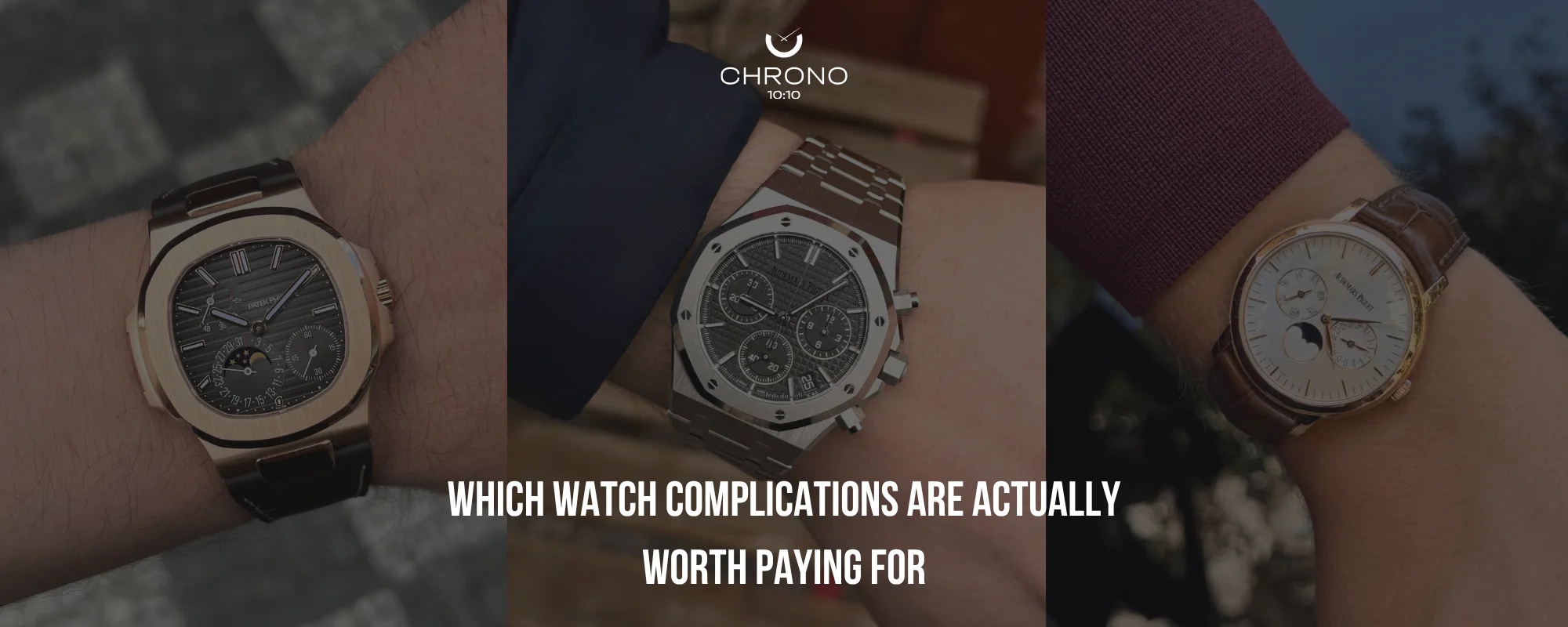
Which Watch Complications Are Actually Worth Paying For
Walk far enough into watches and you'll start hearing about complications, usually in the same breath as eye-watering prices. A complication is any function a watch does beyond telling the time, and some are worth every penny while others are pure showing off. This guide is about sorting one from the other.
We'll go through the big ones, explain what they actually do, and give you an honest take on which are worth paying for. At Chrono 10:10 we handle watches across the whole range, so we've got no reason to oversell you a complication you'll never use.
Let's start with the basics. Bear in mind that the right complication can double a watch's price, and the wrong one just doubles your service bill. The aim is to pay for function or craft you actually care about, not for bragging rights.
What Is a Watch Complication
So what is a watch complication, exactly? In plain terms, it's any feature beyond hours, minutes, and seconds. A date window is a complication. So is a stopwatch, a second time zone, or a display of the moon's phase.
The word sounds fancy, but it just means the movement does extra work. Some of that extra work earns its keep, and some of it exists mainly to impress other watch people. Even the modest date adds gears and cost, which is why some purists prefer a clean, time-only dial.
The trick is deciding which extras pull their weight for the way you live. A complication you never look at is just money sitting on your wrist.
Common complications you'll come across:
-
The date, the day, or a full calendar
-
A chronograph, or stopwatch function
-
A second time zone, like a GMT
-
The phase of the moon
-
A power reserve indicator
Complications Versus Basic Watch Functions
It helps to separate complications from basic watch functions. The core watch functions are the hours, minutes, and usually the seconds, and every watch has those. Anything stacked on top is a complication, even something as ordinary as the date.
The line matters because brands charge a lot for crossing it. Once you know which watch functions you'll actually use, you stop paying for ones you won't.
It's worth saying that a simple time-only watch can cost more than a complicated one. Finishing, movement quality, and the name on the dial all matter as much as the number of functions. More complications don't automatically mean a better watch.
The Main Types of Watch Complications
There are dozens of types of watch complications, but most fall into a few buckets. You've got timing complications like the chronograph, calendar ones like the date and perpetual calendar, and astronomical ones like the moonphase. Then there are travel complications, such as the GMT and world timer, and pure showpieces like the tourbillon (it has its uses, but people mainly buy it because it looks incredibly cool).
Knowing the watch complications that exist makes it far easier to spot which ones suit your life. The categories overlap, but the buckets are a handy map. When a watch combines three or more major complications from different groups, it earns the title grand complication. Those are the summit of the craft, and priced like it.
|
Type |
Examples |
What it does |
|
Timing |
Chronograph |
Times events like a stopwatch |
|
Calendar |
Date, annual, perpetual |
Tracks the date and month |
|
Astronomical |
Moonphase |
Shows the moon's cycle |
|
Travel |
GMT, world timer |
Handles other time zones |
|
Showpiece |
Tourbillon, repeater |
Displays watchmaking skill |
How Mechanical Watch Complications Work
All mechanical watch complications run off the same power source, the mainspring, through extra gears and levers. The more a watch does, the more parts squeeze into the case, which is why complicated watches cost more and need more care.
A perpetual calendar can have hundreds of tiny components doing one clever job. That complexity is why mechanical watch complications are both expensive to buy and expensive to service. It's also why watchmakers are so proud of them.
Quartz watches can do many of the same tricks far more cheaply, since a chip handles the maths. But there's no romance in that, which is why the prestige stays with the mechanical versions. Some are built as add-on modules, while the best are designed into the movement from the start.
The Chronograph Watch
A chronograph watch is a watch with a built-in stopwatch, worked by the pushers on the side of the case. Press the top one to start and stop, the bottom one to reset. It's one of the few complications people actually use, whether for timing a run, an espresso, or a parking meter.
A good chronograph watch is also just fun to operate, with a satisfying click to the pushers. Of everything here, this is one of the easiest to recommend. The Rolex Daytona and Omega Speedmaster are the two most famous examples, and both carry serious history.
Better versions use a column wheel, which gives the pushers a smoother feel, while cheaper ones use a cam. A flyback chronograph can reset and restart in a single press, which pilots once relied on. It's the most popular complication for good reason.
The Annual Calendar Watch
An annual calendar watch shows the date, day, and month, and gets almost all of it right on its own. It knows that some months have thirty days and some thirty-one, so you only correct it once a year, at the end of February.
Patek Philippe invented this one in 1996, and it's one of the smartest everyday complications going. For most people, an annual calendar watch hits the sweet spot between useful and impressive. You get a proper calendar without the eye-watering price of a perpetual.
What makes it clever is the timing. For roughly two hundred years, watchmakers offered either a simple date or a full perpetual calendar, with nothing in between. The annual calendar filled that gap, and rivals took years to copy it. If you want one complication that feels special and still makes sense day to day, this is the one.
The Perpetual Calendar Watch
A perpetual calendar watch takes the idea further and never needs correcting, not even for February in a leap year. Leave it running and it'll track the date correctly all the way to the year 2100. It's a stunning piece of mechanical cleverness, and also one of the most expensive things you can buy.
The catch is that if it stops, setting it again is a faff, and servicing costs a small fortune. A perpetual calendar watch is worth it if you love mechanics and will keep it wound, but it's a luxury, not a necessity.
To enjoy one properly you'll also want to keep it running, often on a watch winder, so it never has to be reset. It's the kind of watch that asks something of its owner.
|
Feature |
Annual calendar |
Perpetual calendar |
|
Correction needed |
Once a year |
Almost never |
|
Knows leap years |
No |
Yes |
|
Rough price |
High |
Much higher |
|
Best for |
Everyday use |
Collectors and purists |
The Moonphase Watch
A moonphase watch shows where the moon is in its cycle through a little disc under the dial. To be honest, nobody needs this. It's the least practical complication on the list, and also one of the prettiest.
A standard moonphase drifts out by a day every couple of years, while clever versions stay accurate for over a century. Buy a moonphase watch because you find it charming, not because it's useful. The romance is the whole appeal, and a good moonphase under a deep blue dial is hard to resist.
The World Timer Watch
A world timer watch shows the time in all twenty-four zones at once, usually with a ring of city names around the dial. It's the more theatrical cousin of the GMT, which simply adds a second time zone.
For someone who travels constantly, a world timer watch is a real tool and a lovely one. For everyone else, it's a gorgeous party trick. If you cross time zones often, it earns its place, and if you don't, a simple GMT does most of the job for far less.
The Tourbillon Watch
Now for the one everyone argues about. A tourbillon watch has a spinning cage that holds the balance and escapement, designed to cancel out the pull of gravity. Breguet invented it in 1801 for pocket watches that sat upright in a waistcoat all day.
On a wristwatch that moves around constantly, the real-world benefit is close to nothing. A tourbillon watch is mostly a show of watchmaking skill, and a very expensive one. Buy it for the artistry and the mesmerising spin, not because it'll keep better time.
The Most Respected Horology Complications
The tourbillon sits among the most respected horology complications, alongside the minute repeater and the perpetual calendar. These are the pieces that make collectors go weak at the knees, and they're priced to match.
The minute repeater, which chimes the time on demand, is probably the most magical of the lot. None of these horology complications are practical, and that isn't the point. They're about craft, history, and the sheer difficulty of pulling them off.
The Power Reserve Indicator
A power reserve indicator is a small gauge that shows how much wind is left in the mainspring, a bit like a fuel gauge. On a hand-wound watch it's properly useful, telling you when it's time to wind again.
On an automatic you wear daily, it matters less, since your wrist keeps it topped up. A power reserve indicator is cheap as complications go, and it adds a little mechanical interest for not much money. It's a modest, sensible feature rather than a grand one.
The Best Watch Complications for the Money
So which are the best watch complications to actually pay for? If you want real-world use, a date, a GMT, and a chronograph give you the most for your money. An annual calendar is the sweet spot if you want something cleverer without losing your mind on price.
The grand complications, like the tourbillon and perpetual calendar, are wonderful, but you're paying for art, not utility. The best watch complications for you come down to whether you value daily usefulness or mechanical theatre.
Complications that tend to earn their keep:
-
A date, the most useful complication of all
-
A GMT for anyone who travels or works across time zones
-
A chronograph you'll actually use and enjoy
-
An annual calendar for clever, low-fuss everyday wear
-
A power reserve indicator on a hand-wound watch
|
Complication |
Worth paying for |
Why |
|
Date or GMT |
Yes |
Useful every single day |
|
Chronograph |
Yes |
Handy and good fun to use |
|
Annual calendar |
Often |
Clever without the perpetual price |
|
Moonphase |
For charm only |
Pretty but not practical |
|
Tourbillon |
For the art |
No real accuracy gain |
Questions to ask before paying for a complication:
-
Will you actually use it, or only admire it
-
Are you happy to cover the higher servicing costs
-
Does it make the watch harder to read
-
Are you paying for usefulness or for craft
-
Would a simpler version do the same job for less
In the end, a complication is only worth it if it adds something to your life, whether that's use or pure joy. There's no shame in buying a moonphase you'll never need, and none in skipping a tourbillon you can't justify. Know what you're paying for, and the choice gets easy.
Frequently Asked Questions
What is the most useful watch complication?
The humble date is the most useful complication for most people, followed closely by a GMT or second time zone. A chronograph comes next, since plenty of people actually use the stopwatch. These three give you the most real-world value for the money. The fancier complications are more about craft than daily use.
Is a tourbillon worth the money?
For accuracy, no. On a wristwatch a tourbillon offers almost no real timekeeping benefit, since your wrist already moves the watch around. What you're paying for is the artistry, the engineering, and the hypnotic spinning cage. If you love watchmaking and can afford it, it's a wonderful thing, but it's a want, not a need.
What is the difference between an annual and a perpetual calendar?
An annual calendar needs correcting once a year, at the end of February, while a perpetual calendar handles even leap years on its own. The perpetual is far more complex and far more expensive. For most people the annual calendar offers the better balance of cleverness and price. The perpetual is really one for collectors.
Do complications make a watch harder to maintain?
Generally yes. More moving parts mean more that can wear or break, and servicing a complicated watch costs more and takes longer. A perpetual calendar or minute repeater is a serious commitment to look after. A simple date or power reserve, on the other hand, adds very little upkeep.
Which complication should I buy first?
Start with something you'll use, like a date, a GMT, or a chronograph. These add real function without a huge jump in cost or maintenance. Once you know you love watches, you can explore the fancier complications. Buying for daily use first tends to lead to fewer regrets.
Verwandte Artikel