François-Paul Journe Is Buying EBEL
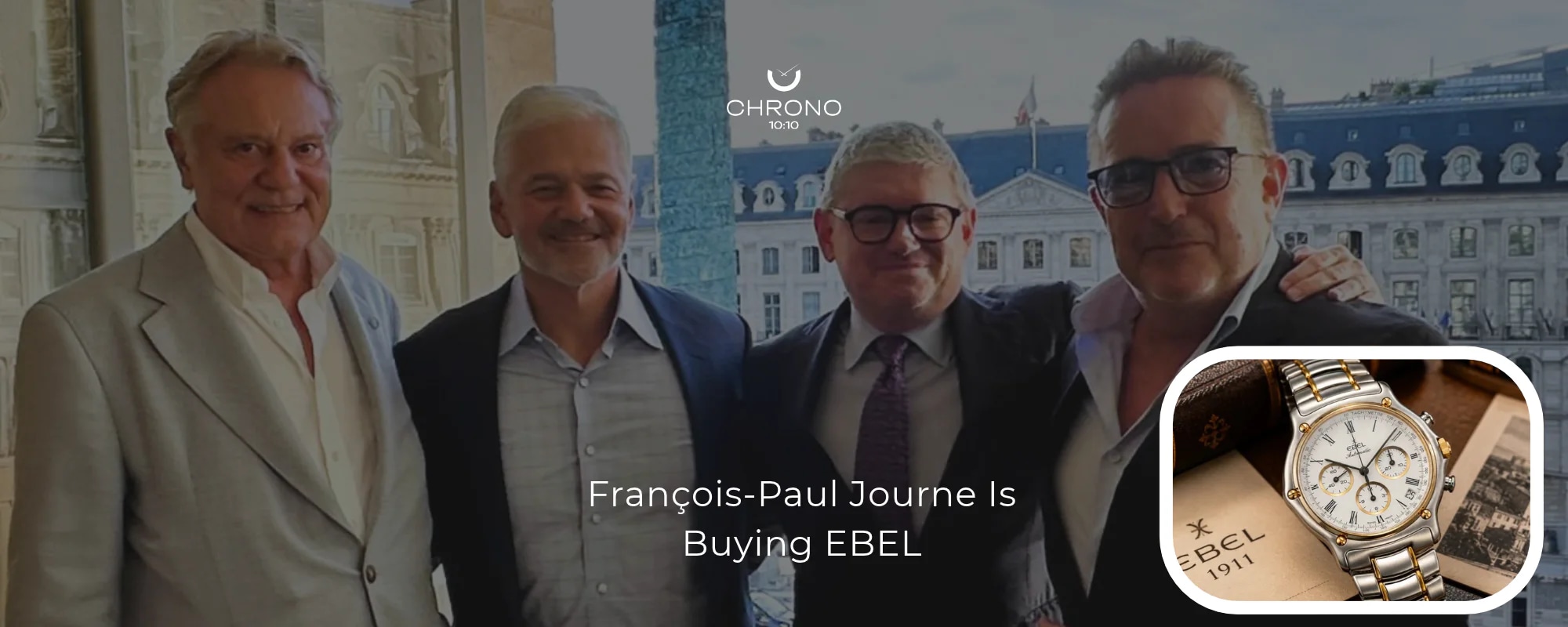
Movado Group has agreed to sell 95 percent of EBEL for 66.5 million dollars to a group led by Montres Journe, the company behind F.P. Journe, with Chanel as a partner and Pierre Jacques, who ran De Bethune for well over a decade, as chief executive. Movado keeps five percent. The deal should close within a few months, and nobody involved has said a word about what the watches will look like.
So the interesting question is what François-Paul Journe, the most collected independent watchmaker alive, sees in a brand that most people under forty know only from a pawn shop window.
A Brand That Got Big While Everyone Else Got Small
EBEL was founded in La Chaux-de-Fonds in 1911 by Eugène Blum and his wife Alice Lévy, and the name is simply their initials, Eugène Blum Et Lévy. For its first sixty years it was a respectable movement and watch maker among hundreds of others in the Jura.
The change came with Pierre-Alain Blum, the founder's grandson, who took over in the early 1970s just as Japanese quartz began demolishing the Swiss industry. Most companies in his position closed or sold. Blum went the other way. EBEL built its own quartz movements and components, made watches for Cartier, and in 1977 launched the Sport Classic, a steel and gold watch with screws set into the bezel and a bracelet of curved links that collectors still call the wave. It looked expensive, wore beautifully, and cost a sensible amount.
By the 1980s EBEL was one of the five largest watch manufacturers in Switzerland, with more than 500 people on the payroll. Don Johnson wore an EBEL 1911 chronograph through Miami Vice, and that watch ran a Zenith El Primero movement, years before Rolex put the same calibre into the Daytona. EBEL even bought a house designed by Le Corbusier in La Chaux-de-Fonds, the Villa Turque, and used it to receive clients. Very few watch companies have ever had that much confidence.
Then Blum's other businesses ran into trouble and he sold in 1994. Investcorp owned it, then LVMH from 1999, then Movado from 2004, and under each of them EBEL drifted further from what had made it work. It became a department store brand, competent and forgettable, and the Villa Turque became the most interesting thing it owned.
What Journe Brings That Others Could Not
EBEL has been revived before, at least on paper, and every attempt treated it as a marketing problem. Journe's statement on the deal reads like a deliberate rejection of that approach. He quoted Michelangelo on the product, the product, the product, which is a fair summary of how he has run his own company since 1999.
Start with dials. Journe owns Les Cadraniers de Genève, a dial maker he co-founded in the year he started his brand, which supplies other high-end houses as well as his own and runs a workshop dedicated to restoring historical dials and reproducing vintage designs from original drawings. An old brand being relaunched by a company that already reconstructs vintage dials for a living is a rare piece of luck. The Sport Classic and the 1911 depend on their dials for almost all of their character, and getting them right is where most revivals fall apart.
Then there is quartz, which is the part I find most promising. In 2014 Journe released the Élégante, an electro-mechanical quartz watch that took him eight years to develop. It goes to sleep after about half an hour without movement, keeps counting time on its microprocessor, and when you pick it up the hands find their way back to the correct time by the shortest route. The battery lasts up to eighteen years in standby. The haute horlogerie world was horrified when he announced it, and the Élégante now trades well above retail on the secondary market.
EBEL's best years were built on quartz. The company survived the crisis that killed its neighbours by making better quartz watches than the Japanese, finished and cased to Swiss standards, and the Élégante proves Journe takes the technology seriously when almost no one else at his level does. A properly developed EBEL quartz movement, finished with care and sold at an honest price, would fit the brand's history better than another automatic in a steel case.
And there is his name. Journe's watches are among the most sought-after on Earth, his early pieces sell for seven figures, and collectors follow his taste with near-religious attention. His name on the ownership register changes how serious buyers look at EBEL before a single new watch exists. That effect cannot be bought with advertising.
Where Chanel and Pierre Jacques Come In
Chanel has owned 20 percent of Journe's company since 2018 and has spent the years since buying stakes across Swiss watchmaking, in Romain Gauthier, MB&F, Bell & Ross, Kross Studio, and Kenissi, the movement manufacturer controlled by Tudor that also supplies Breitling and others. That last holding matters. A brand relaunching at volume needs reliable mechanical calibres at a reasonable cost, and Chanel already sits inside one of the best sources of them in Switzerland.
Pierre Jacques brings the operating experience. De Bethune is a small, engineering-led independent that built a reputation on unusual mechanics and high finishing, and running it for more than a decade means he knows how to keep a small brand alive through a bad market, which is exactly the market EBEL is about to relaunch into.
The Risk
Journe makes fewer than a thousand watches a year and his entire value rests on that scarcity. EBEL at its peak made a great many more, and nobody pays 66.5 million dollars for a brand they intend to keep tiny. The two businesses need opposite things.
The obvious mistake would be to turn EBEL into a junior Journe, small production at five-figure prices aimed at collectors who already own one of everything. Breitling has just relaunched Universal Genève at the top of the market after paying more than 60 million francs for it, and that strategy may work for a brand whose legend lives in rare vintage chronographs. EBEL's legend is different. It was a watch that people bought, wore every day and kept for thirty years, and its whole appeal was quality that did not require a waiting list.
The better path keeps EBEL where it lived, in steel and gold, with quartz and mechanical options, priced so a successful professional can buy one without a second mortgage, built with the attention Journe brings to everything he touches. Done well, it gives Journe's group a brand that can grow without endangering the scarcity of the one carrying his name.
What to Watch For
Collectors had already started moving before this announcement. Alfredo Paramico, one of the more influential vintage collectors in Italy, sold a large part of his EBEL collection through a themed Phillips auction in 2024, and a Sport Classic chronograph made more than 17,000 francs there. Good examples of the 1911 and the Sport Classic have been climbing for a while, and this deal will push them further.
If you own an EBEL from the Blum years, keep it. If you have been thinking about buying one, the cheap window is closing as of this week.
The first new watches are probably a year or two away. When they arrive, look at the dial first and the bracelet second, since those are the two places where EBEL's identity lived and where Journe's workshops are strongest. The Villa Turque transfers with the brand, and I would not be surprised to see it back in use for its old purpose, receiving the clients of a watch company that finally has owners who care about what it makes.
Verwandte Artikel